

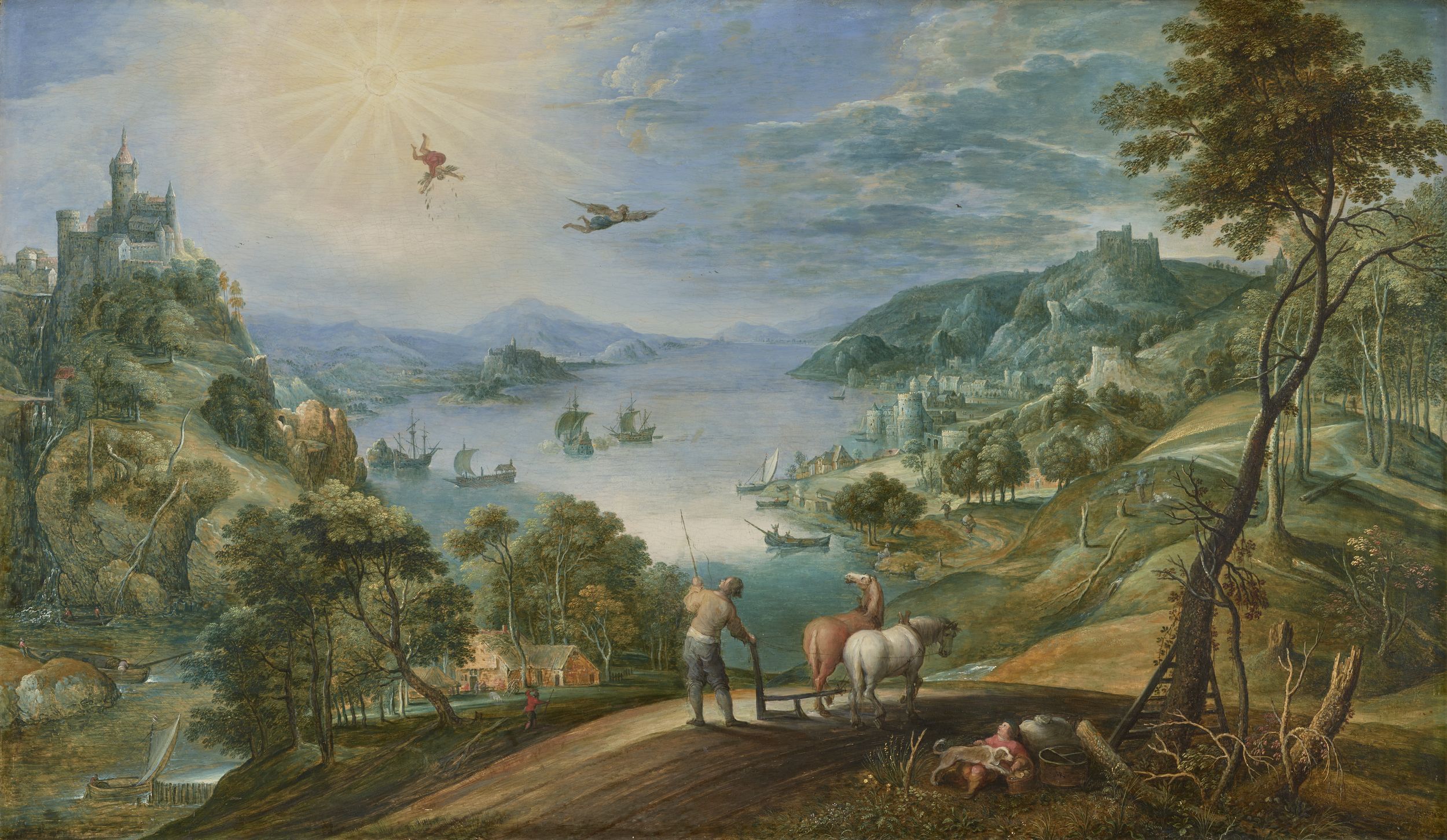
MARTEN RIJCKAERT
1587 - Antwerp – 1631
A Flemish landscape painter, Marten Rijckaert grew up in a family of artists: his father, the painter and art dealer David Rijckaert I (1560 – 1607), was his first master, after which he became the pupil of the landscape painter Tobias Verhaecht (1561 – 1631). Between 1607 and 1611, he stayed in Italy. Although he may have worked in the workshop of Paul Bril (1553/1554 – 1626), his talent asserted itself, his compositions gained in scope and his palette was tinged with the light of the South. On his return to Antwerp in 1611, he joined the Guild of Saint Luke and also became a member of the rhetorical chamber Den Olijftak (the Olive Branch) as of 1621.
Initially influenced by Jan Brueghel the Elder (1568 – 1625), he chose to lighten his palette to bring greater clarity to his painting. His work, composed of small touches and fine glazes, was daring for its time. He invented and perfected his own style: strong colours or impasto in the foreground, then lighter colours painted in lively strokes in the background. In addition, the composition of his paintings is always rich in detail. Sometimes inspired by Pieter Bruegel the Elder (c. 1525 – 1569), his works are rarely signed, but his distinctive approach to foliage, with its often dense and rounded tufts, as well as certain specific motifs, make him easily identifiable. His manner of painting water is particularly remarkable. In his later works, while retaining his talent as a colourist, Marten Rijckaert demonstrated a keen sense of composition that made him one of the greatest landscape painters of his time.
Antoon van Dyck (1599 – 1641) painted his portrait: he is depicted with a missing left hand, which he lost in an accident. The Guild archives named him “the one-armed painter”.
Find out more