

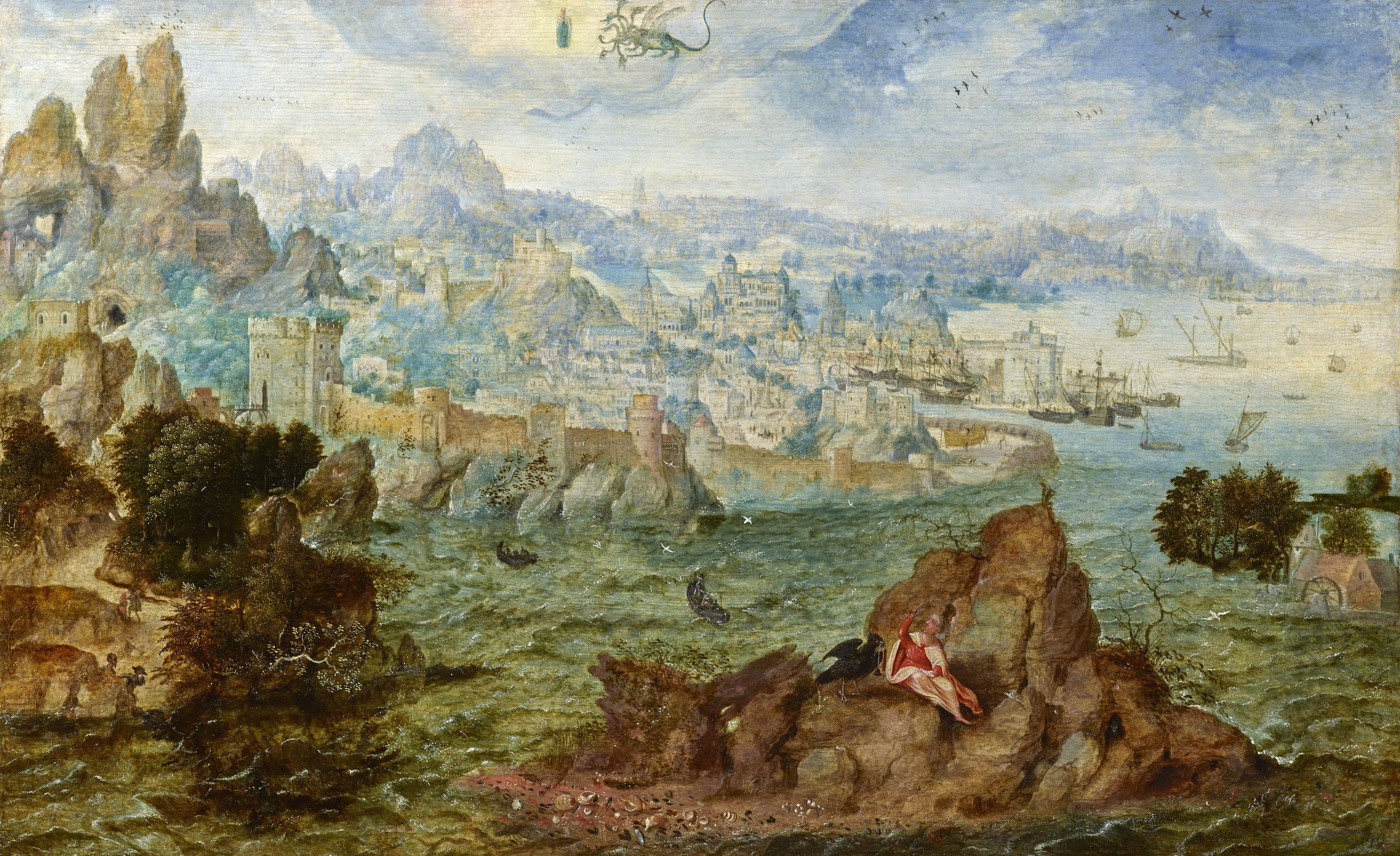
HERRI MET DE BLES
Circa 1510 Dinant or Bouvignes-sur-Meuse – Active in Antwerp between 1533 and 1566
After a long stay in Italy, Herri Met de Bles settled in Mechelen in 1521, then Amsterdam where Frans Mostaert (1528 – 1560) became his pupil. A painter of animated panoramic landscapes and religious, mythological or popular scenes, Herri met de Bles followed the pictorial tradition of Joachim Patinir (c. 1475/1480 – 1524), who may have been his uncle. Entering the Guild of Saint Luke in Antwerp in 1535, he was one of the great pioneering masters of landscape painting, having taken over a prolific workshop after Patinir's death. Surpassing all his contemporaries in this genre, he pioneered a new conceptual approach to space. The realistic yet imaginary places are an extension of this tradition, especially regarding the rocky precipices with their fanciful configurations; here, he expresses his talent through a less rigid and more vaporous atmosphere. The master was also inspired by the principles of Leonardo da Vinci, who recommended allowing distant objects to disappear into a light mist to emphasise the effects of air and to enhance perspective. During his trips to Italy, he was known by the name of ‘Civetta’ after the owl that featured in his paintings.
In 1572, he appeared alongside Jan van Eyck (1390 – 1441), Hieronymus Bosch (c. 1450 – 1516) and Pieter Bruegel the Elder (c. 1525 – 1569) among the 26 most famous painters of the Low Countries cited in 1572 in Les effigies des peintres célèbres des Pays-Bas by Dominique Lampson (1532 – 1599) and Hieronymus Cock (1518 – 1570). His engraved portrait bears the words “he worked around 1550 and his signature was an owl”; this anecdote is repeated three times by Karel van Mander in Het Schilder-boeck of 1604.
Find out more