

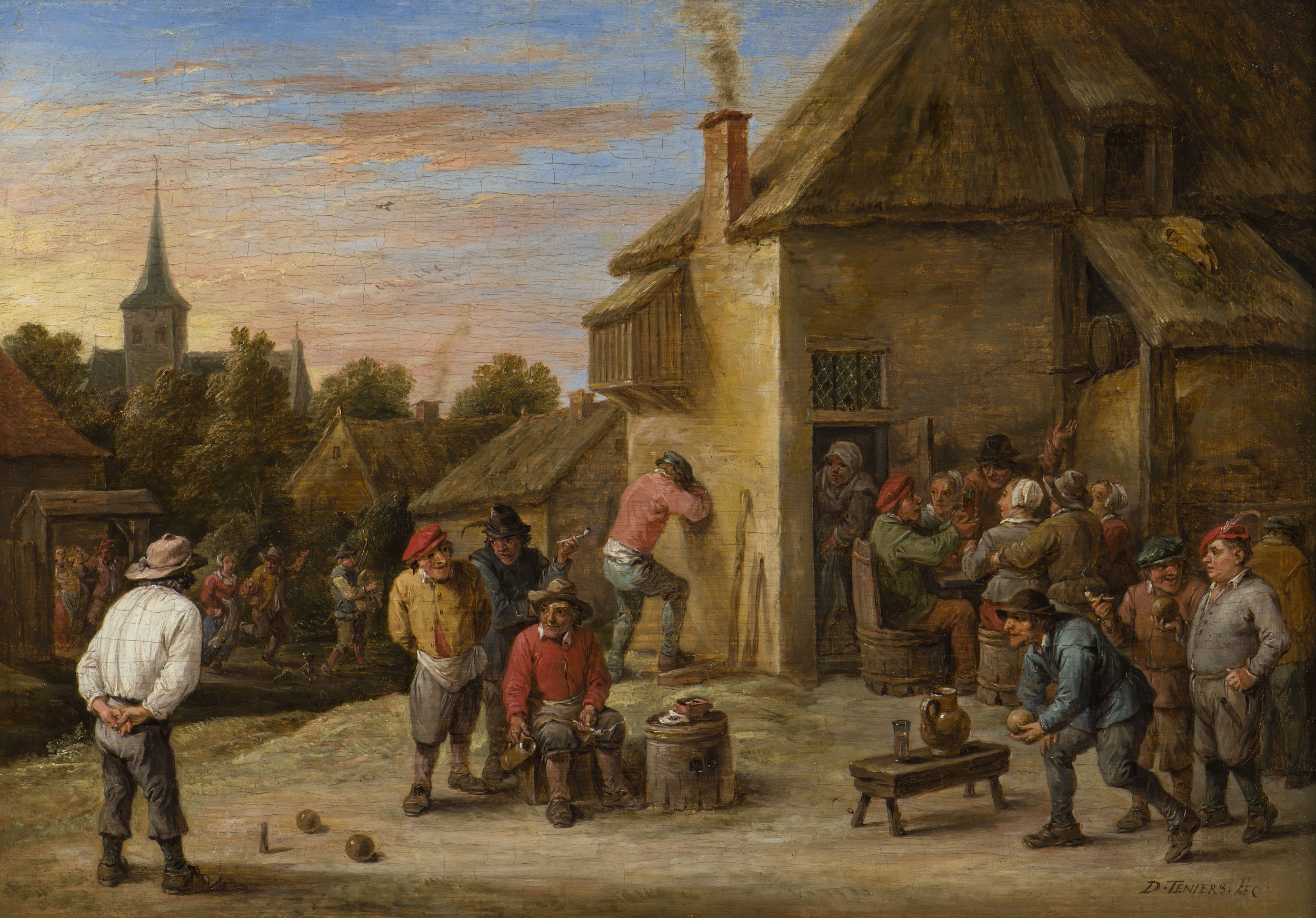
DAVID TENIERS THE YOUNGER
Antwerp 1610 – Brussels 1690
David Teniers the Younger is one of the greatest Flemish genre painters of the 17th century. Son of the painter David Teniers (1582 – 1649), he became a master of the Guild of Saint Luke in Antwerp in 1633. Several years later he married Anna, the daughter of Jan Brueghel the Elder (1568 – 1625). He began by painting landscapes in the style of his father-in-law and Paul Bril (1553/1554 – 1626), while his first genre scenes reveal the influence of Adriaen Brouwer (c. 1603/1605 – 1638). He then developed a personal style that combined light tones and warm colours. He also broadened his range of themes and besides rustic scenes, he painted works featuring magicians, witches, doctors and alchemists. His characters are sometimes replaced by costumed monkeys or cats.
In his genre scenes, Teniers significantly extended Brouwer’s iconographic repertoire, depicting many kermises and other popular festivities. His profound interest in rural life can clearly be seen in the impressive number of rustic scenes he painted, but also in his small-scale portraits of peasants. However, it is in paintings such as the Village feast in the Prado in Madrid, the Drinker at a table in the Louvre, or Smoking in the Petit Palais Museum, that the artist’s mastery reaches its pinnacle. In 1645, he was elected dean of the Guild of Saint Luke in Antwerp. He then settled in Brussels in 1651 after being appointed court painter by Archduke Leopold Wilhelm of Austria (1614 – 1662) and curator of his collection. From this period onwards, his style adapted to the visual and moral requirements of the court and he began to move away from rural scenes in favour of religious, mythological and literary subjects: he painted allegories and contemporary events as well as portraits. His village scenes still served as cartoons for tapestries throughout the 17th and 18th centuries.
Find out more