

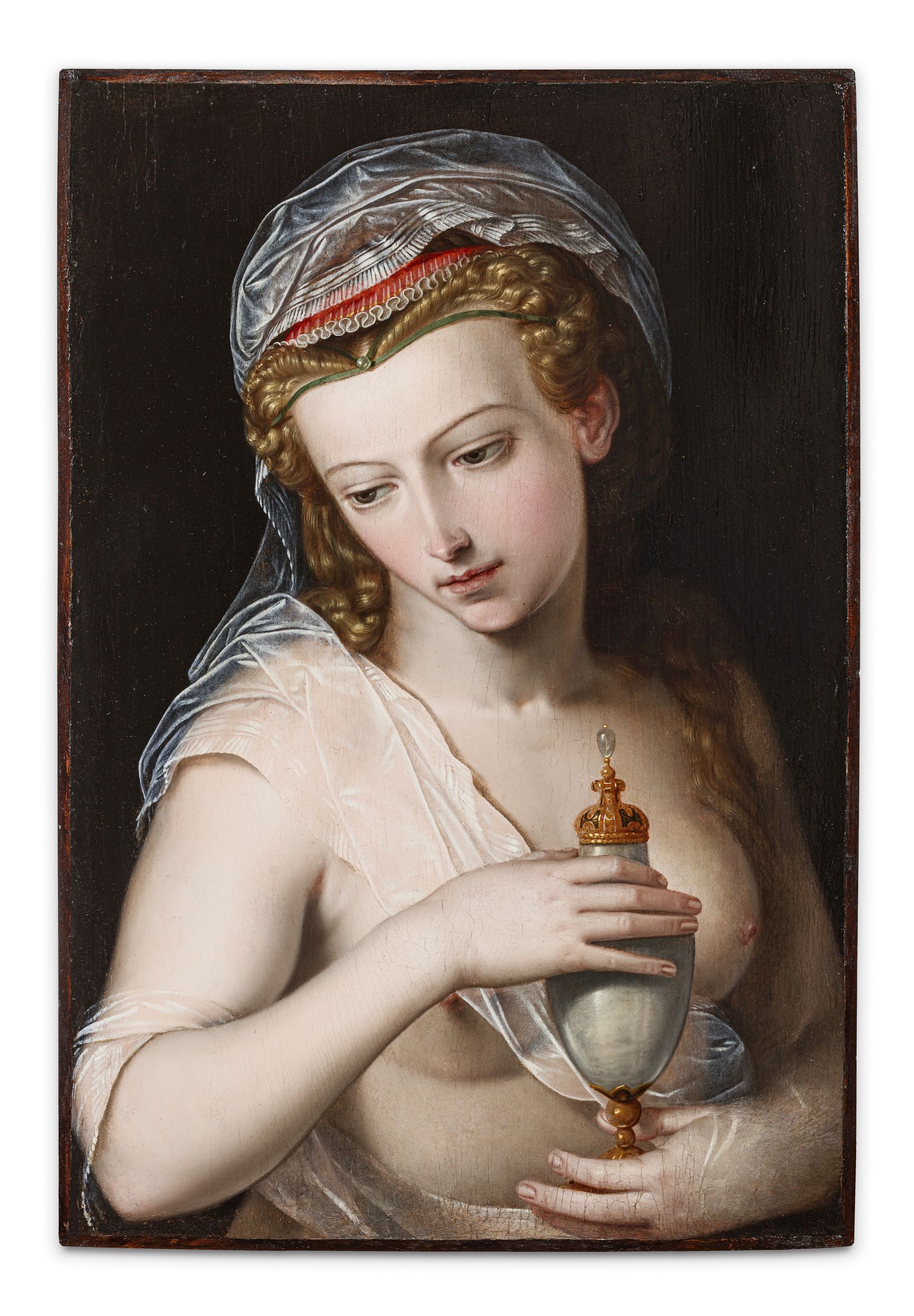
ADRIAEN THOMASZ. KEY
Cica 1545 – Antwerp – Circa 1589
A painter, draughtsman and engraver from Antwerp, Adriaen Thomasz. Key wasn't in fact related to Willem Key, although he was his pupil. The latter was a recognised master who studied the Italian style of Lambert Lombard and worked with Frans Floris. In 1568, when he was accepted as a master of the Antwerp Guild, Adriaen Thomasz. took over the workshop of his master who died the same year. During his apprenticeship, Key had given him the responsibility of producing large parts of his work.
Hence, the name Key doesn't designate a family relationship but an artistic one. According to Koenraad Jonckheere, this is a unique case of a pupil taking over his master's name . An account by Dean Frans Francken indicates that ""Ariaen Tomas alias Key"" went by the name Key although this was not his birth name. His name was Adriaen and that of his father Thomas, while Key was the name of his master which he assumed as an alias. This name would become a mark of quality, guaranteeing superior materials as well as technical and artistic excellence.
The body of work of Adriaen Thomasz. Key is mostly composed of portraits. Since there are few details about his life, the personalities he painted allow us to better understand the social environment in which he evolved, and the people who appreciated his art. Among his clients was the House of Orange, in particular William the Silent whose portrait he painted.
Besides Willem Key, Adriaen was strongly influenced by the style of Michiel Coxcie to whom he made numerous references. As a Calvinist in the war-torn Netherlands in the second half of the 16th century, he came into contact with a number of fellow Calvinists, including Gillis van Coninxloo and Frans Pourbus the Elder, a pupil of Frans Floris. His eclectic style is characterised by the finesse and rigour of his stroke. The precision with which he paints fabrics, hair and skin tones is certainly striking. His familiarity with the living model and nature and his ability to translate what he observed enabled him to produce works of surprising quality.
Find out more