

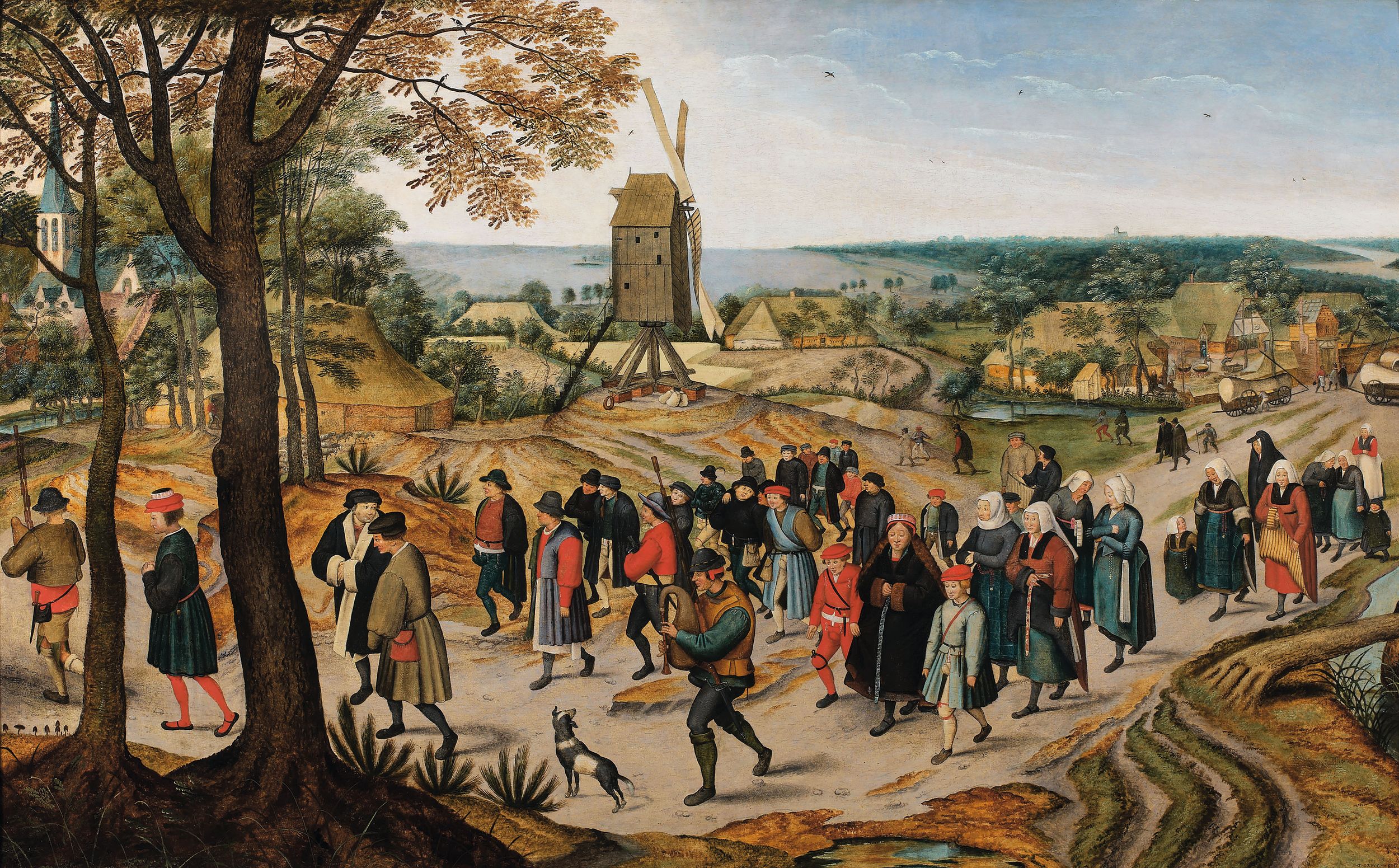
PIETER BRUEGHEL THE YOUNGER
Brussels 1564 – Antwerp 1638
He was the eldest son of Pieter Bruegel the Elder (c.1525 – 1569) and settled early on in Antwerp, where he trained in the studio of the landscape artist Gillis van Coninxloo (1544 – 1607). He became a master in 1585. His father died in 1569 when he was only five years old, and was thus unable to introduce his son to painting. His mother, Mayken Verhulst (c. 1545 – 1578), the daughter of the painter Pieter Coecke van Aelst (1502 – 1550) and herself a painter, died when he was in his teens, but she contributed to his apprenticeship. In 1588, he married Elisabeth Goddelet (died 1638) with whom he had seven children.
He was nicknamed ""Hell"" Brueghel even though scenes of hell were an exception in his work. There were two periods in Pieter Brueghel the Younger’s work. Initially, he copied many of his father’s paintings and developed several versions of them. He added his personal touch by introducing variants, including a significant focus on landscape and his own particular colours that were more vivid and pure than those used by his father.
The second period began circa 1615-1620. He asserted his personality through the creation of original compositions, which were met with great success from the outset, also inspiring several variants. His son Pieter Brueghel III (1589 – 1638) and Frans Snijders (1579 – 1657), the famous painter of still lifes and animals, were his students. In addition to perpetuating his father’s oeuvre, Pieter Brueghel the Younger was held in high esteem in the 17th century, in particular because of his fine brushwork and the purity of his colours. All in all, he was highly successful during his lifetime and had a lasting influence on the Flemish painters of his era. His particularly fruitful career spanned almost half a century.
Find out more