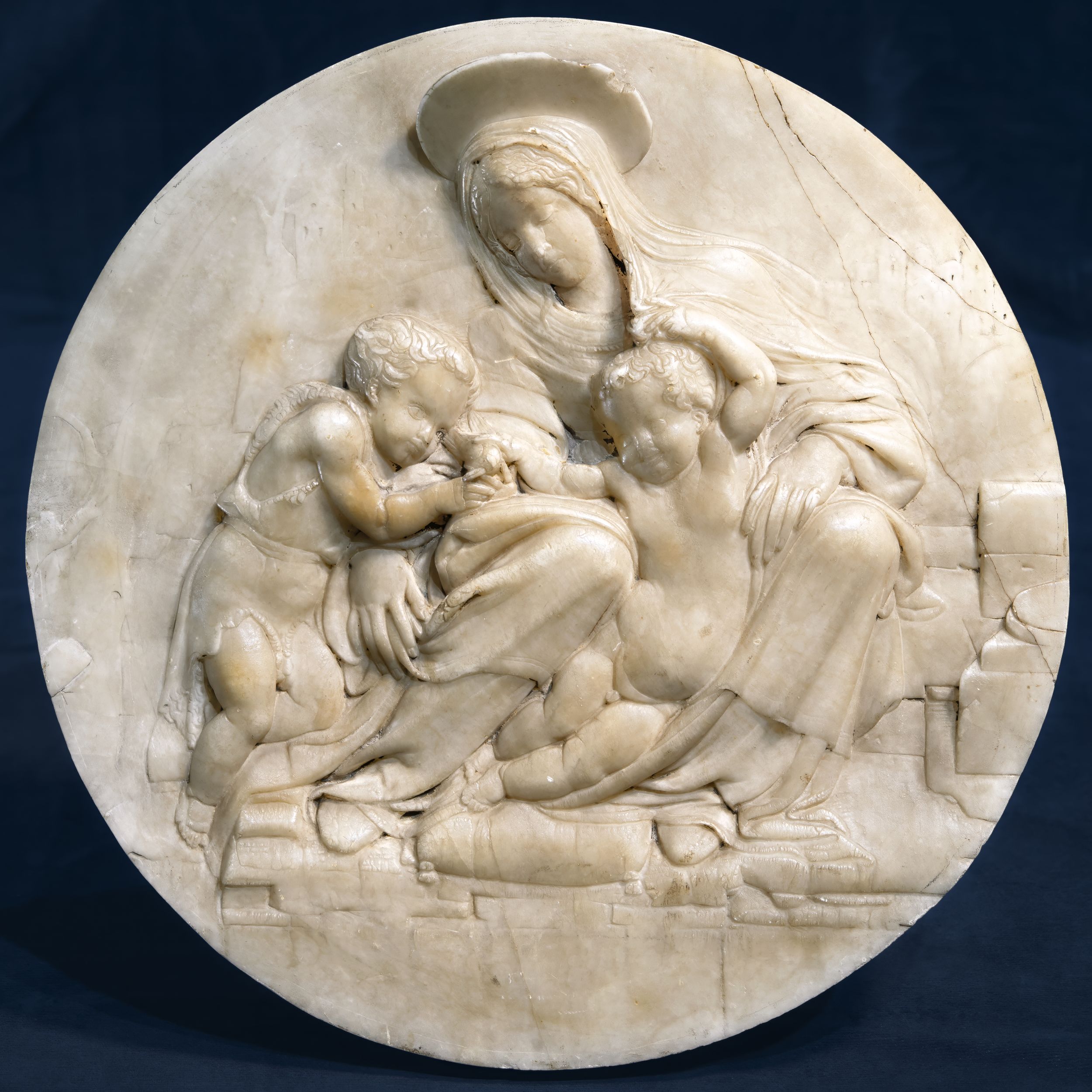
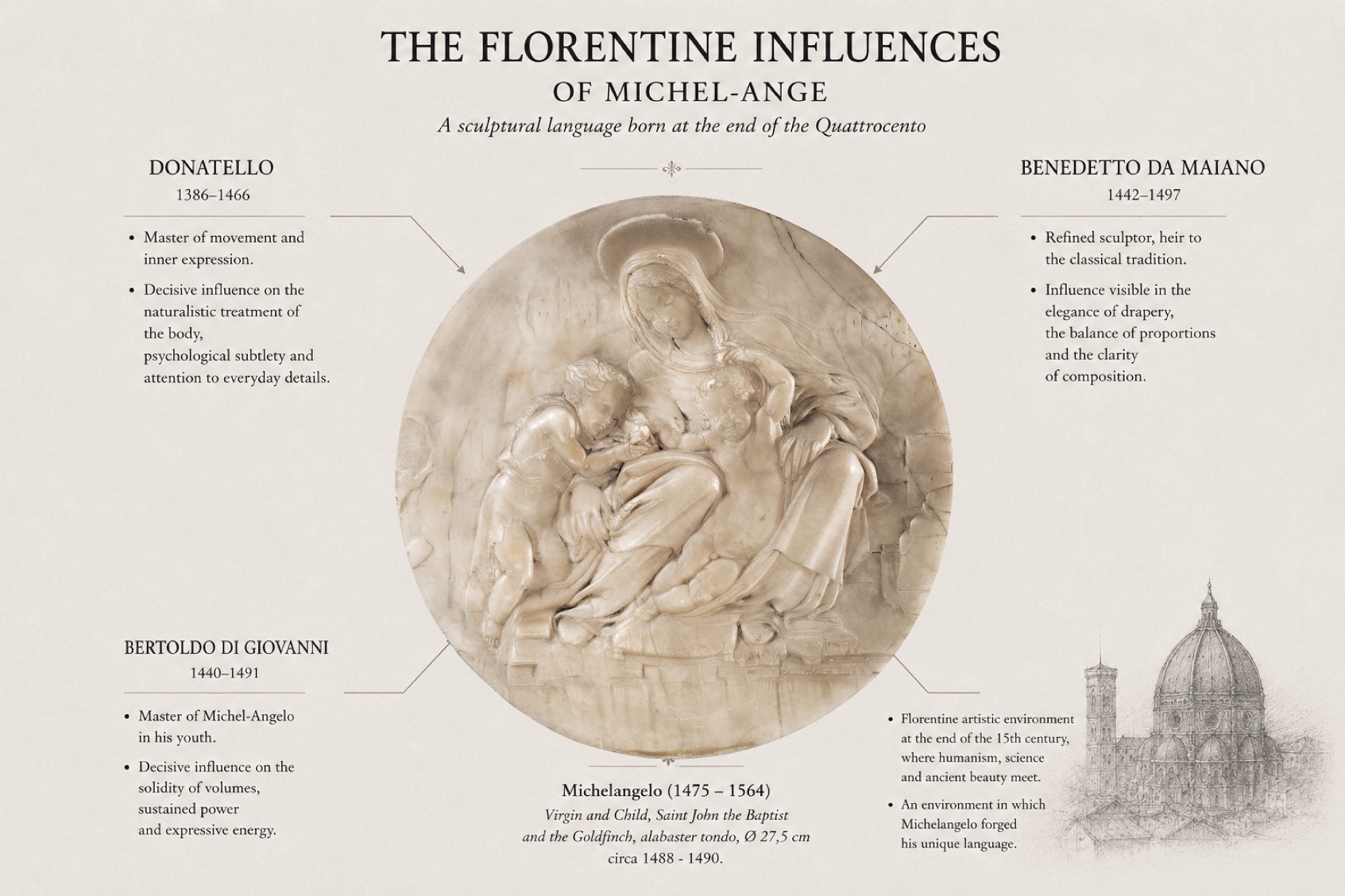
 Michelangelo (1475 – 1564)
Virgin and Child, Saint John the Baptist and the Goldfinch, circa 1488 - 1490, alabaster tondo, Ø 27.5 cm
Michelangelo (1475 – 1564)
Virgin and Child, Saint John the Baptist and the Goldfinch, circa 1488 - 1490, alabaster tondo, Ø 27.5 cm
A NEW INSIGHT INTO MICHELANGELO
A fundamental discovery in Renaissance art is this first sculpture by Michelangelo, executed between
the ages of 13 and 15.
One of the two alabaster tondi recorded in the inventory drawn up after the death of Lorenzo de’ Medici in 1492, the admirer, host and patron of the young Michelangelo in Florence.
The inventory drawn up after Lorenzo de’ Medici’s death in 1492 records more than 20 alabaster sculptures, including two tondi, as well as several other objects carved in alabaster. These references confirm that alabaster works were present in the Medici collection and circulated within the artistic environment in which the young Michelangelo was trained.
"Quattordici pezzi d’alabastro , grandi et picoli, che ve n’è dua tondi"
" 14 pieces of alabaster , large and small, including two tondi "
(1492, Lorenzo de ’Medici inventory)
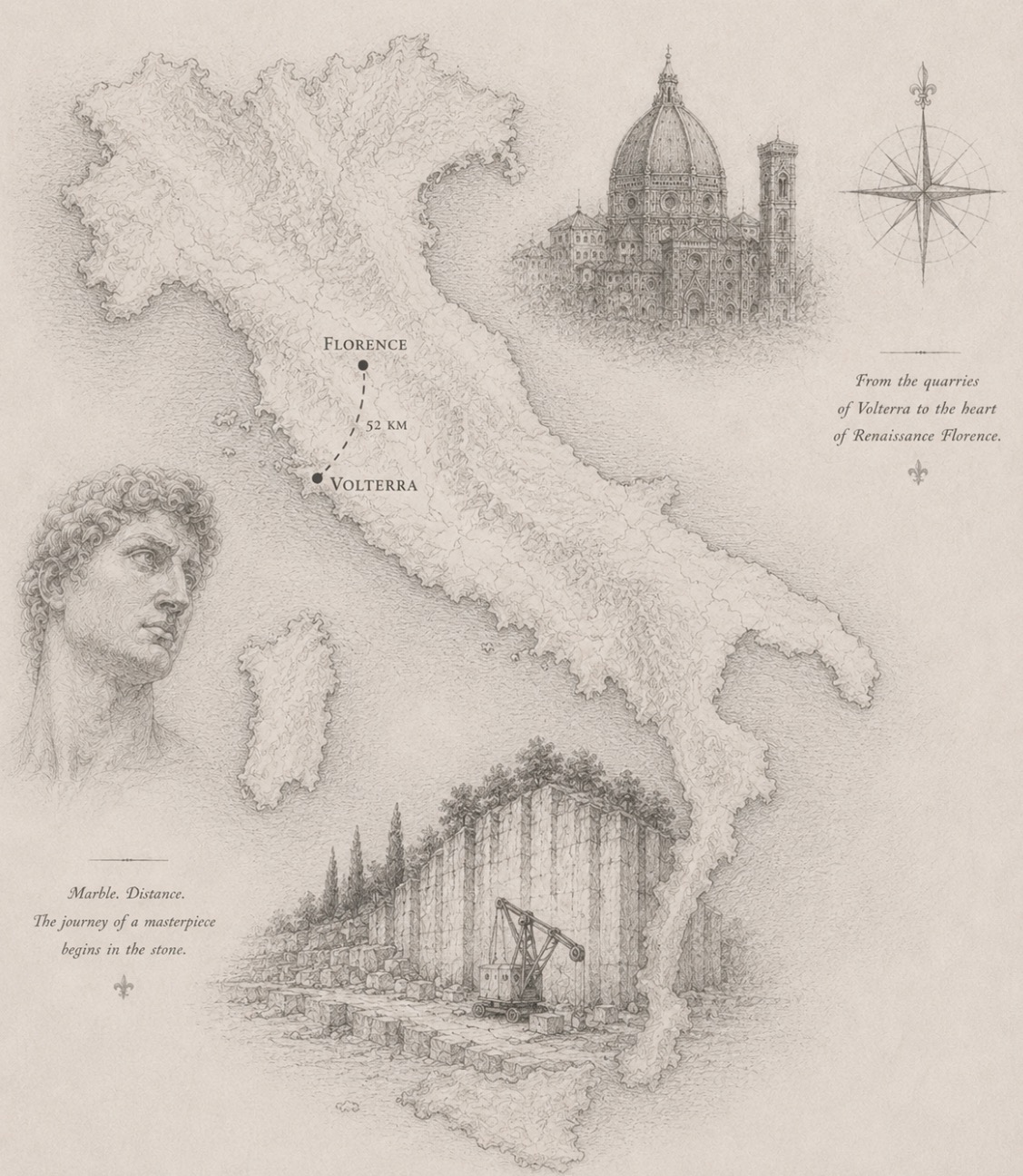
The use of alabaster is therefore fully consistent with the Florentine context of the late Quattrocento. The alabaster quarries of Tuscany, around Volterra, had been exploited since Etruscan antiquity and supplied Florence with a material appreciated for its ivory tone and its natural translucency identical to our sculpture. Softer and easier to carve than marble, alabaster allows a delicate and intimate modelling particularly suited to religious subjects.
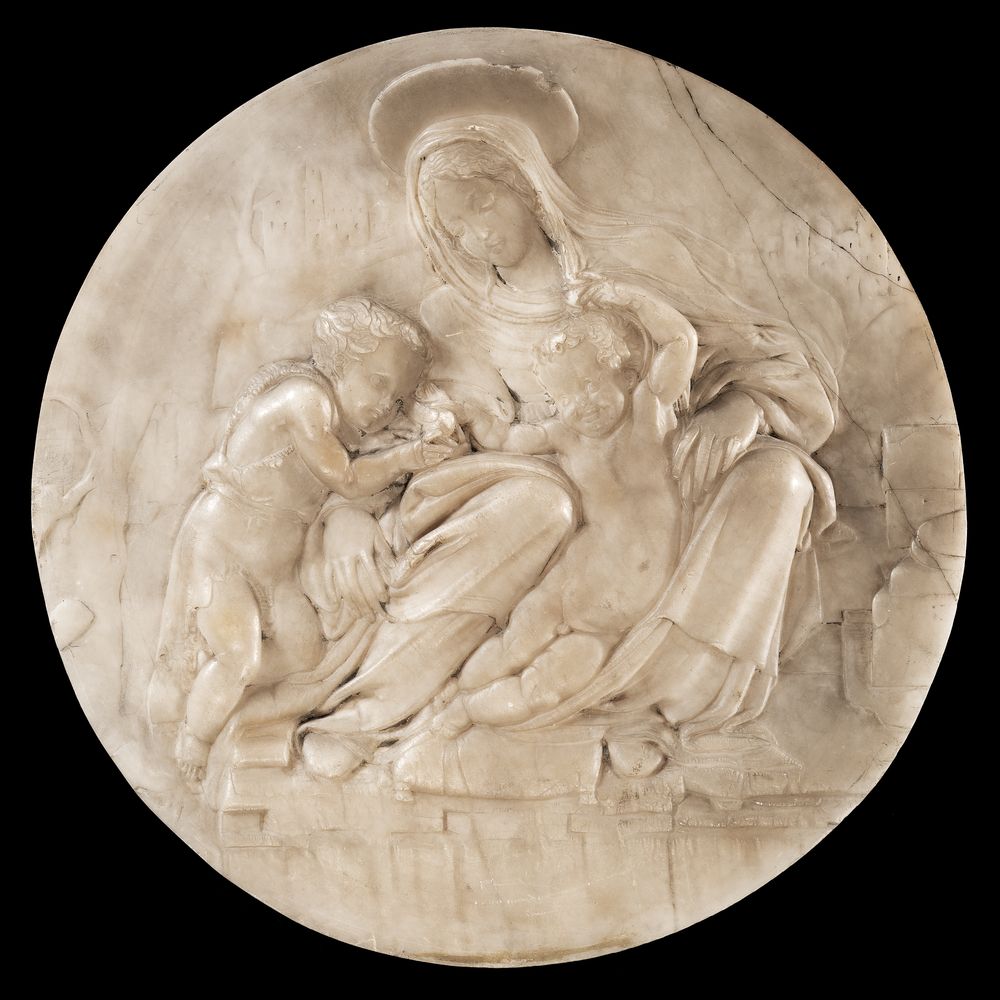
The iconography and composition of the present tondo correspond to the formal language developed by Michelangelo in his youth. The subject of the Virgin and Child with Saint John the Baptist and the Goldfinch belongs to Florentine Quattrocento devotional imagery and appears again in Michelangelo's later Taddei Tondo. The composition follows a pyramidal structure with the Virgin forming the apex, while the Christ Child stands between her knees, a compositional invention by Michelangelo. The figures are placed on a stone pedestal and accompanied by the motif of a felled tree, elements very frequently present in Michelangelo's early sculptures. The Christ Child stands in a contrapposto position that introduces movement and dynamism, another defining feature of the artist's work.
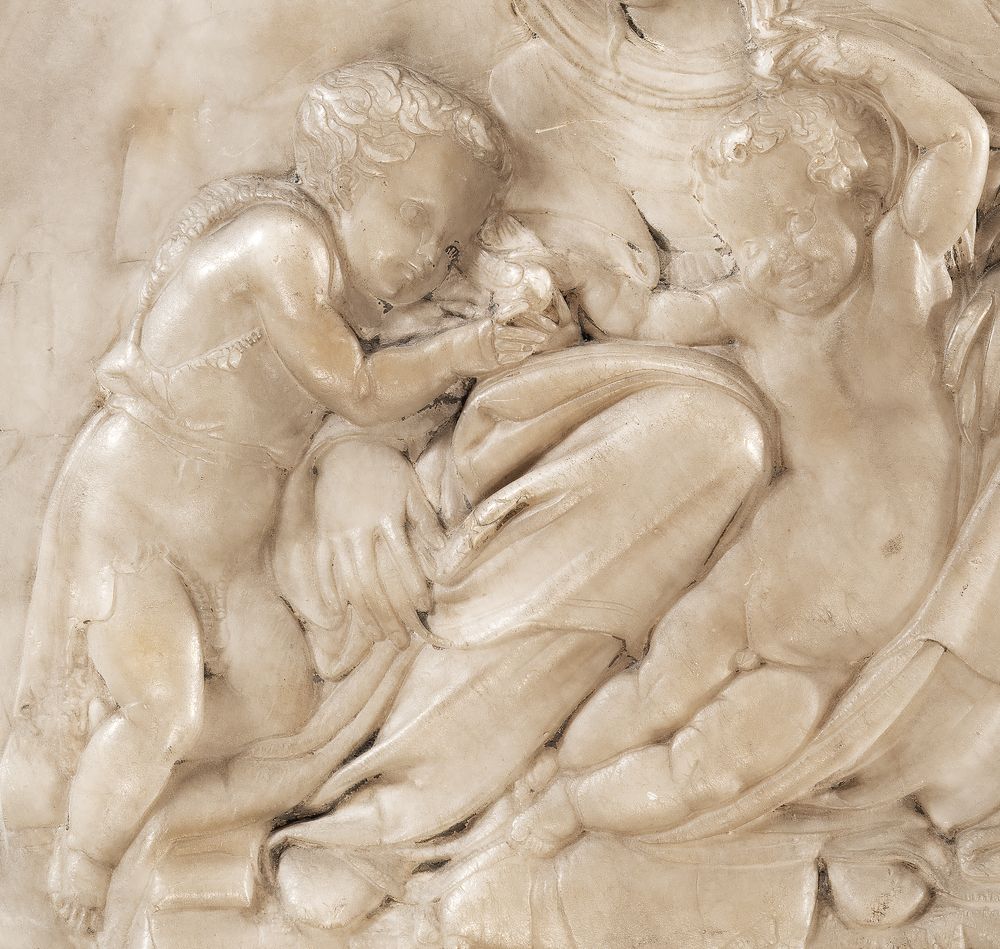
The children display the physical characteristics typical of Michelangelo's youthful figures: high foreheads, small curls of hair, soft anatomy and lively expressions. Saint John the Baptist wears a camel-hair garment tightened with a double belt at the waist, a detail found in all early representations of the saint in Michelangelo's early work.
Stylistically, the sculpture reflects the Florentine Renaissance environment in which Michelangelo was trained. The refined treatment of drapery, the attention to anatomy and the expressive modelling of the faces correspond to the artistic language of Florence at the end of the Quattrocento and reveal the influence of the masters who shaped his formation, notably Bertoldo di Giovanni, Benedetto da Maiano and Donatello.
As Giorgio Vasari noted, “Michelangelo embarked on the imitation of the works of Donatello.”
In the Madonna of the Goldfinch, c.1506, by Raphael, the influence of the present tondo is more clearly evident than that of the Taddei Tondo.
At that time, Raphael was working in Florence and had access to the artistic environment and collections connected to the Medici circle, to which the present tondo also belonged.
Striking similarities can be observed, notably in the iconography of the Virgin and Child with Saint John the Baptist and the Goldfinch, as well as in the pyramidal composition and the harmonious interaction between the figures. In both works, Saint John the Baptist holds the Goldfinch with both hands while Christ Child places his right hand upon the bird, creating a central symbolic motif linked to the Passion.
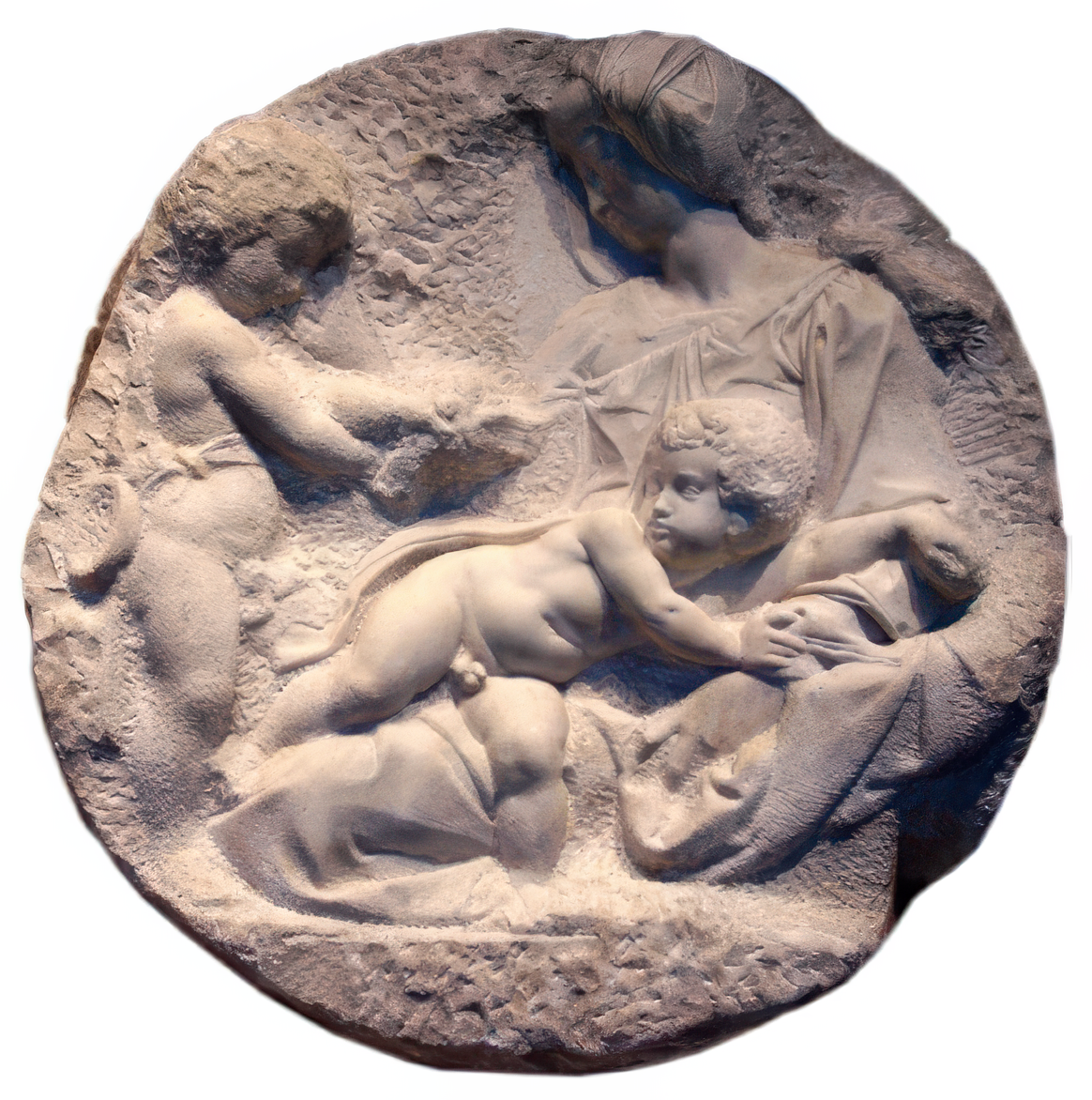
Michelangelo ( 1475 - 1564)
The Taddei Tondo: Virgin and Child with Saint John the Baptist and the Goldfinch, marble tondo, c.1500-1504, Ø 106.8 cm
© Royal Academy of Arts, London.
Michelangelo (1475 – 1564)
Virgin and Child, Saint John the Baptist and the Goldfinch, alabaster tondo, c.1488-1490, Ø 27.5 cm
Private collection
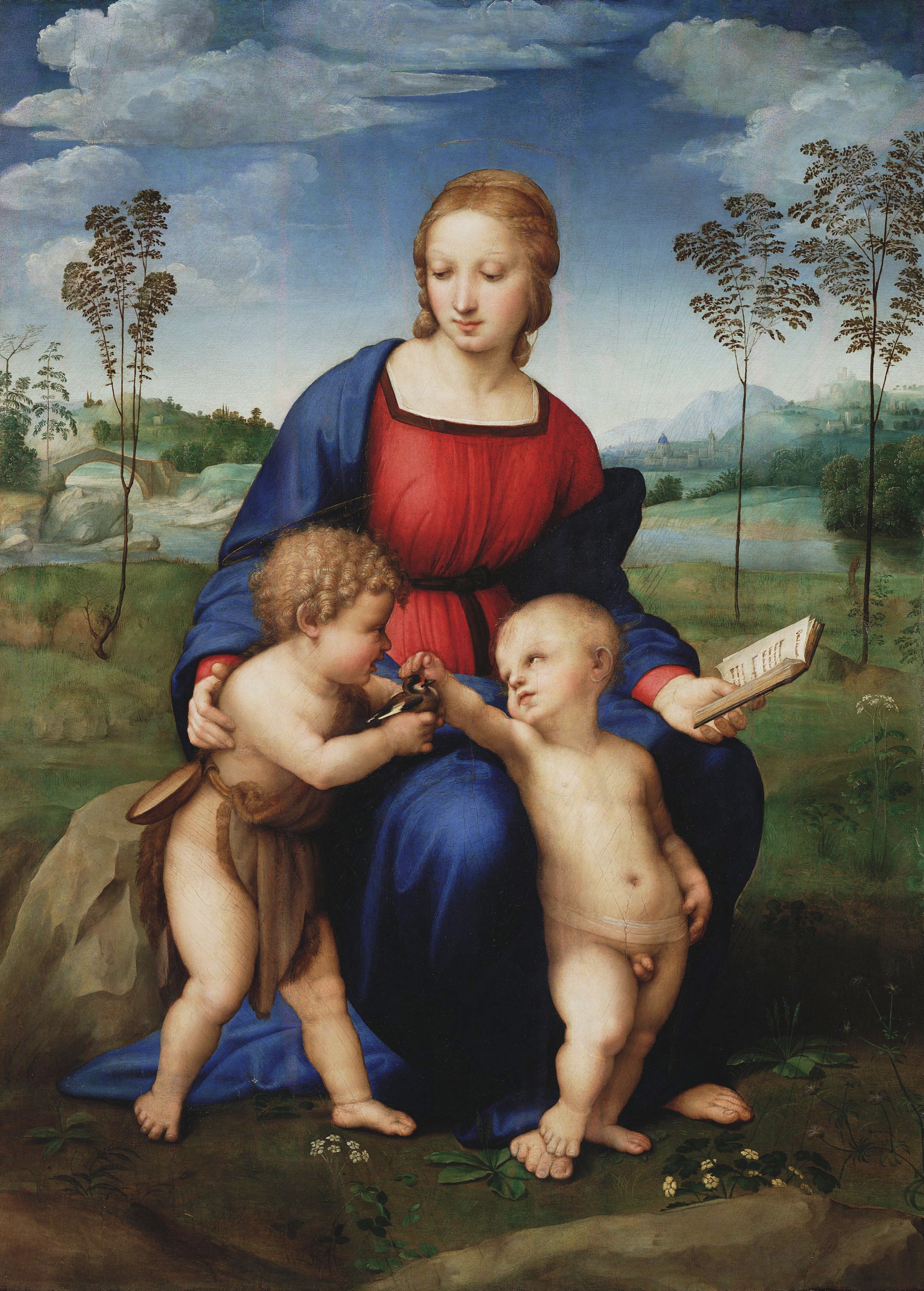
Raphael (1483–1520)
Madonna of the Goldfinch
oil on panel, c.1506, 107 x 77 cm
© Galleria degli Uffizi, Florence